
Why Journalism Matters
A victory for press freedom at the Pentagon--but the military fights back. UK newspapers succeed in winning against AI's power over copyright. And remembering courageous war photographer Paul Conroy

4 minute read
The ongoing battle for freedom of the press at the Pentagon

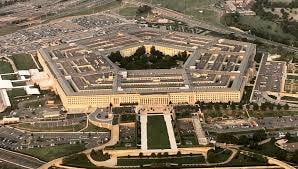
We live in an era where freedom of information and expression is a constant source of contention. Paradoxically this is the case despite the tsunami of news and opinion flowing around us 24/7.
Nevertheless, where those freedoms are being encroached by the authoritarian predispositions of even democratic governments, it’s worthwhile taking time to showcase the ongoing battles and tactical victories that underscore how protecting those rights and freedoms works in practice.
One such drama is playing out in the heart of the Pentagon, HQ for the world’s most powerful military.
Earlier this month Judge Paul Friedman, a U.S. District Court judge for the District of Columbia, overturned the Department of Defence’s recent change in press policy, ruling it in violation of the Constitution’s first amendment which guarantees freedom of the press.
The judgement was the result of a lawsuit brought by the New York Times after the Pentagon announced that it would be introducing restrictions on access to journalists because of ‘security’ concerns.
Refused to sign
Under the restrictions announced in October many media outlets - including CBS News, ABC News, NBC News, CNN, Fox News and even BBC News had their access revoked. This happened when they refused to sign a document which required them to agree that any information they gathered had to be approved for release even if it was unclassified.
The current Pentagon press corps is currently made up primarily of conservative Trump-supporting outlets like the One America News Network who signed the document.
Another is Gateway Pundit who spread false information about the 2020 election. The outlet settled a defamation lawsuit brought by two Georgia election workers it falsely accused of wrongdoing. Gateway Pundit was also forced to admit there was no fraud in the election.
Friedman also struck down one of the most controversial restrictions which could bar reporters who tried to ‘solicit’ sensitive information.
What journalists do
As he wrote in his judgment: “To state the obvious, obtaining and attempting to obtain information is what journalists do.”
“Under the Policy’s terms, then, essential journalistic practices that the plaintiffs and others engage in every day - such as asking questions of Department employees - could trigger a determination by the Department that a journalist poses a security or safety risk.”
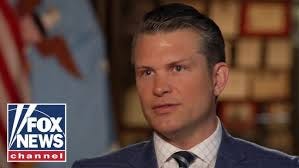
“A primary purpose of the First Amendment is to enable the press to publish what it will and the public to read what it chooses, free of any official proscription,” wrote Friedman in his judgement.
“Those who drafted the First Amendment believed that the nation’s security requires a free press and an informed people and that such security is endangered by governmental suppression of political speech.
“That principle has preserved the nation’s security for almost 250 years. It must not be abandoned now.”
He added:“Especially in light of the country’s recent incursion into Venezuela and its ongoing war with Iran, it is more important than ever that the public have access to information from a variety of perspectives about what its government is doing.”
Fighting back
But as WJM goes to press the Pentagon is fighting back against the judgement. The department has announced all journalists will require an authorised escort to access the Pentagon and that the Defence Department has closed the “Corresponents Corridor’ inside the main building, announcing that a new press space will be established outside.
Reporters can only have access to the building when accompanied by an authorised escort, and this even includes toilet breaks!
Pentagon spokesman Sean Parnell gave the following explanation:
“The Department remains committed to transparency and to working with credentialed journalists who cover the Department and the U.S. military.
“The Department is equally committed to the security of the Pentagon and the protection of the men and women who work there. The revised policy reflects both commitments.”
(In an unrelated case, also adjudicated this month Friday’s a federal judge ruled to restore the operations of Voice of America, a government-funded international news organisation that Trump had ordered shut down last year, shuttered by executive order.)
Reference
New York Times report on judgement
3 minute read
UK press campaign succeeds in battle to help beat back the AI onslaught against copyright
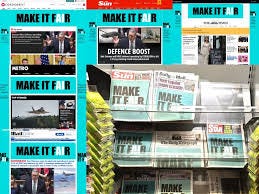
There was also a victory in the realms of copyright protection in the UK this month. Following the‘Make it Fair’ campaign launched by hundreds of newspapers last year with a front-page wraparound on all the national newspapers, the government has withdrawn its proposal to allow wholesale access to copyright material (including editorial content) by AI companies.
The UK government says it must make time to “get this right.”
There was united opposition to the original proposal by the creative industries including by high profile figures like Sir Elton John, Sir Paul McCartney and writer Sir Philip Pullman. The government initially proposed allowing AI companies to train their models with an opt-out option for copyright holders, circumventing more than 300 years of copyright protection under British law, the oldest in the world.
In announcing the climbdown Technology Secretary Liz Kendall said: “We have listened.” She confirmed the government no longer favours that approach.
However, it’s not yet clear what the government will do next.
She added the government is “genuinely trying to find a way forward that seeks to back and champion our incredible world-leading creative industry” while also supporting the AI sector.
The government’s published assessment commented that UK culture is a “world-leading national asset”, while noting the AI industry is growing “23 times faster” than the rest of the economy
Chief executive of UK Music Tom Kiehl hailed the development as “a major victory for campaigners” pledging to work with the government.
Satisfaction with result
The UK press bible the Press Gazette recorded its satisfaction with the result.
“Good news from the UK government yesterday as it reacted to overwhelming opposition from the creative industries to its position on copyright and AI.
“This follows a rare show of unanimity among every UK national newsbrand last year in the form of the Make It Fair campaign.
“It [the government] had favoured a presumption that AI companies could use whatever they want for training unless copyright holders opted out.”
The Press Gazette is also hopeful that there will be an increase in revenue for news outlets from search engines like Google who will have to pay for news content and other creative material which drives traffic to their platform.
News Media Association chief executive Owen Meredith said: “We are pleased that the Government has listened to concerns and taken the unworkable opt-out copyright exception off the table, recognising that giving away our goldmine of creative content is not the way to drive UK growth.
“By the same logic, the Government must now swiftly dismiss other exceptions that could be even more harmful, particularly an exception for ‘science and research’ or ‘commercial research’.
“AI firms should now focus on meaningful engagement with news publishers to secure licenses to access their rich breadth of content, and the Government must make clear that this is what they expect.”
These copyright-AI battles are being fought around the world, and this is a hopeful sign that they can be won.
No one knows what the final outcome of this situation will be, but one can only hope it will lead to a happier relationship than what now exists between the press and the Pentagon.
Reference
3 minute read
Remembering Paul Conroy: the war photographer with a sense of humour who risked his life to make a difference
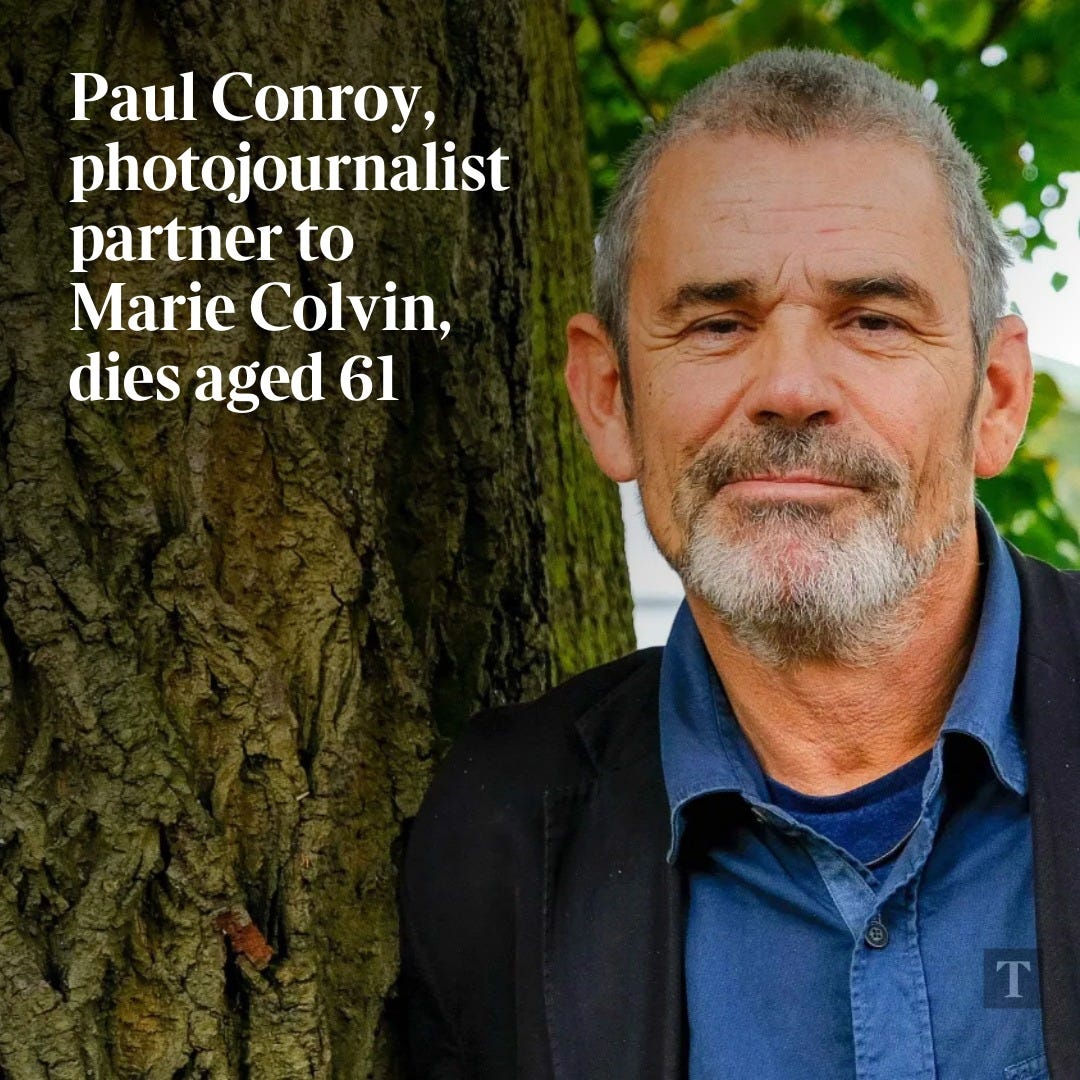
It’s one thing believing in and supporting press freedom with protests and campaigns. Quite another putting your life on the line and working with others who are doing the same.
That was the life of Paul Conroy, the fearless British photo journalist from Liverpool who died last month. Ironically Paul (61) did not die under fire in some far off foreign war zone, but of a heart attack while visiting his family back home in Devon.
Paul was most famous for working with the legendary Sunday Times war correspondent Marie Colvin. They were together in Homs in Syria at the height of the civil war that wracked that country for more than a dozen years. They had sneaked in illegally in 2012 to report on and confirm the Assad regime was targeting and killing civilians, only to become targets themselves.
An artillery strike on the press centre that they shared with other international journalists killed Colvin and French photojournalist Rémi Ochlik.
Paul was severely injured, and nearly died himself, but somehow survived emergency surgery without anaesthetic and was smuggled back out of Syria they way they came in—through a three-mile sewage tunnel. He later recounted this ordeal in his book Under the Wire, later made into a documentary film.
He spent many months in hospital after coming back from Syria and endured more than 23 operations.
Combat situation
In a sense Paul had been working up to that moment from the beginning of his adult life. He joined the Royal Artillery when he was just 16 and served seven years as a gunner. He said later that his military experience provided him with the skills to survive in combat situations. He then went on to pay his dues as a combat photojournalist, covering wars in the Balkans, Afghanistan, Congo and Libya.
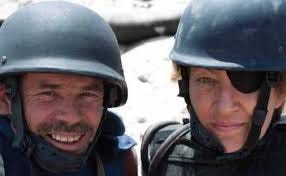
Although his health never completely recovered, combat reporting was in his blood and after the Russian invasion of Ukraine he moved there where he embedded with the Ukrainian military on the frontline in Donbas and gave ‘safety’ training to Ukrainian journalists, something he recalled with characteristic Scouse humour afterwards.
As he explained: “And then at the tea break, these Ukrainian journalists start googling me and they realise that the guy who is teaching them to be cautious rode a motorbike down a sewer for three miles to get into Homs. And then they go ‘what the fuck’!’”
I had the privilege of meeting Paul and spending an evening with him. He kindly came up to our small town in Northamptonshire in 2019 to speak at a screening of Under the Wire for our documentary film group. The description ‘ordinary bloke’ remains in my mind with the addendum “who lived an extraordinary life with unbelievable courage and fortitude”.
He even found time to explain to me how to edit and transfer photographs from a laptop in a warzone. Surprisingly straightforward but I haven’t managed to put into practice as yet!
Colourful and affectionate
His friend and colleague John Sweeney wrote a colourful and affectionate obituary of Paul in the Byline Times which gives an insight into Paul’s casual bravery with a recent anecdote.
Since the war in Ukraine every year there’s a trendy festival entitled aptly,if outrageously, “Vladimir Putin: Do Fuck Off” which ‘celebrates’ the Russian dictator’s birthday.
Sweeney wrote: “…Paul Conroy answered a question about drones from the former British diplomat, Arthur Snell, in his trademark guttural Scouse: “Ironically, with all of this high-tech development, when you spend time down in the grey zone, turns out one of the best defences against these super high tech machines is a twelve gauge shotgun.
“We need the British aristocracy down in Kramatorsk with some pate and some Pimms. The skies would be clear in a week.”
But behind the humour was serious commitment. Paul’s brother Alan paid a moving tribute to Paul’s life mission.
As Alan told the BBC: “He did all his life what he wanted to do to make a difference – he found great pleasure in exposing wrongs.”
Paul Conroy may have died away from the battlefield, but he never gave up on the battle.
Reference
It’s free to subscribe and you can cancel any time, so give it a try!
Contact us on greatjournalismwjm@gmail.com
Follow us on Facebook
facebook.com/whyjournalism matters