
Why Journalism Matters
Press freedom issue. The worst ever year for RSF's press freedom index but we study two shining examples of hope for protecting journalists and fostering investigative journalism in a dangerous world

4 minute read
Championing press freedom in a world where it is under constant attack
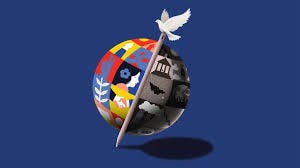
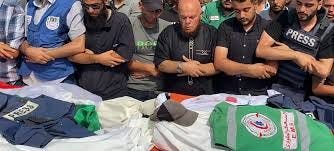
As we mark yet another United Nations Press Freedom day, commemorated on Sunday May 3, all the indicators point to a world where, far from being honoured and protected, the press’s role is under relentless attack and denigration by authoritarian governments, organised criminals and an increasingly distrustful, even hostile public.
Commemorations this year were particularly poignant in Gaza, the site of the deadliest war ever for journalists. According to the latest figures from the Committee to Protect Journalists (CPJ), Israel has killed 259 media workers in the conflict since the Hamas terror attack on October 7, 2023, 210 of them Palestinian journalists inside Gaza.
Every year on Press Freedom Day the Paris-based journalism non-profit Reporters Without Borders (RSF) takes the opportunity to publish their press freedom index, based on analysis and research done in 180 countries. This year the average score for the index is the lowest in the 25-year history of the index.
A major feature in 2026 is the situation in the United States, a country that enshrines press freedom in its constitution and has always been a beacon of progressive journalism around the world. Trump’s America has fallen seven places in the rankings and other countries in the Americas, such as Ecuador and Peru, have also plummeted.
This is how RSF summarises the Trump administration’s attack on the press: “Since returning to the White House in 2025, President Trump has extended the war on the press he launched while running for his first presidential term.
“He has censored government data, attempted to dismantle US public broadcasters, weaponised independent government agencies to punish media that criticise his actions, halted aid funding for media freedom internationally, sued disfavoured outlets, and applied pressure to install cronies to lead others.
“Press freedom in the United States continues to decline as a result of these actions.”
Inaction is endorsement
For the tenth year in a row Norway holds the top spot in the index while Eritrea comes in last for the third year running. Encouragingly, post-Assad Syria has seen the biggest improvement in press freedom of all the countries and territories in the 2026 Index, climbing 36 places in the ranking.
Anne Bocandé, RSF’s editorial director poses a serious question in the light of the 2026 findings. “How much longer will we tolerate the suffocation of journalism, the systematic obstruction of reporters and the continued erosion of press freedom?”
“Authoritarian states, complicit or incompetent political powers, predatory economic actors and under-regulated online platforms are directly and overwhelmingly responsible for the global decline in press freedom.

“Given this context, inaction is a form of endorsement. It’s no longer enough just to state principles – effective measures to protect journalists are essential and must be seen as a priority.
“This starts with ending the criminalisation of journalism: the misuse of national security laws, Slapps [strategic lawsuits against public participation] and the systematic obstruction of those who investigate, expose and name names.”
This assessment is echoed by the International Federation of Journalists(IFJ).
Windhoek declaration
IFJ president Dominique Pradalié said: “Since the adoption of the Windhoek Declaration in 1991, little has been done to better safeguard journalists in international law or conventions. The freedom and security that journalists require to do their jobs is absent in many parts of the world.
“Today, Israel appears determined to silence Gaza’s journalists, including targeting them. Crimes against journalists must not go unpunished. We urge governments across the world to publicly acknowledge their support for a binding international instrument that protects journalists”
According to the UN, attacks on journalists and journalism are proliferating across the world. UNESCO’s most recent report on global trends in freedom of expression, reveals a 10% decline in freedom of expression worldwide since 2012, a setback comparable only to three other periods – World War I, the prelude to World War II, and the late 1970s Cold War period.
UNESCO has also looked into the issues of self-censorship caused by intimidation. Journalists are also facing increased legal harassment, and abuse online—particularly targeting women.
Research carried out by the International Centre for Journalists’ (ICFJ) for UN Women, in partnership with UNESCO found that 75% of women journalists reported having experienced online violence. Even more worrying, at least 42% of women journalists said in 2025 that these online attacks had led to offline abuse, threats or violence – double the number (20%) who reported this in 2020.
In the light of these worrying developments it’s illuminating to look into current public attitudes towards these issues. The respected media US research organisation the Pew Research Centre has published a survey which tries to dig into the underlying ideas that the public have about freedom of expression in general, and press freedom in particular.
It seems that although people think these values are important to society, they don’t sense that freedom in their daily experience of life.
Global Debates
Pew reports: “Amid global debates about press freedom, free speech and freedom on the internet, new surveys of 35 countries show there is a disconnect between how people rate the importance of these freedoms and how free they actually feel to express themselves.”
“Overall, a median of 61% of adults across 35 countries say having freedom of the press in their country is very important, with another 23% saying it is somewhat important. But only 28% say the media are completely free to report the news in their country, with an additional 38% saying the media are somewhat free.
“Similarly, a median of 59% globally say having freedom of speech in their country is very important, while 31% say speech is completely free where they live. This so-called “freedom gap” – where the share of people who value free speech is larger than the share who believe they have it – appears in 31 of the 35 countries surveyed.”
In contradistinction to these negative and troubling assessments, it’s inspiring to discover the incredible bravery and innovation of individual journalists and collective media organisations around the world. Those who take on the battle against the authoritarian, often criminal forces around them in the pursuit of justice and a better global social order.
Two of their stories follow below.
Reference
UNESCO Press freedom events 2026
3 minute read
Fighting for press freedom in the most dangerous and difficult places
In this article, and the one following, WJM is proud to celebrate two remarkable journalistic organisations (and there are many others) that cover some of the most dangerous and difficult countries in the world— either from within or from exile.
Their work represents an invaluable resource of factual and verifiable news about regimes, conflicts and injustices that otherwise would remain hidden.
They are a reminder to those who threaten, torture and kill people under their control that the world is still watching, preparing for the time when a reckoning will be had for grave wrongdoings and unforgivable crimes.
Their efforts also demonstrate that there is a crucial role to be played by all of us fortunate enough to inhabit nations where journalists (and citizens) do not live in constant, tangible fear of being locked up, threatened or even murdered. A role to support, shelter and amplify the work of those journalists so as to underline the importance of these rights in all countries.
Sudanese Journalists Syndicate
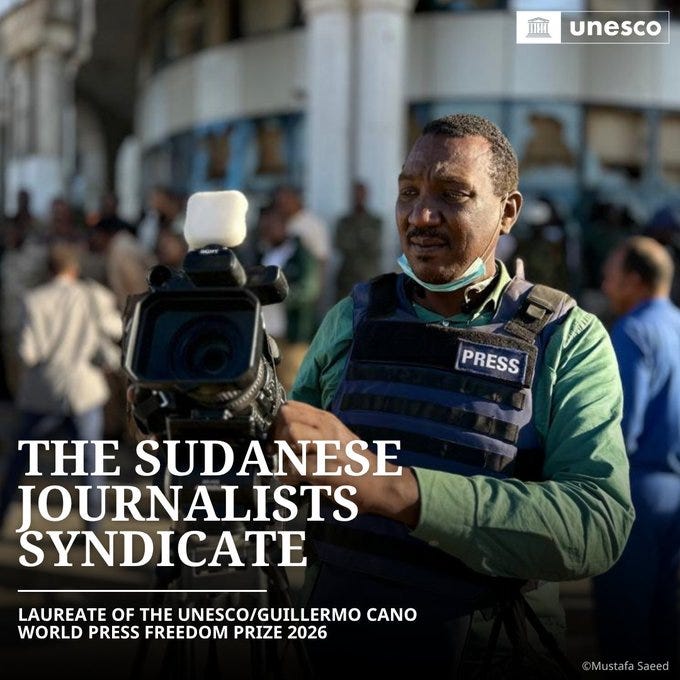
Let’s start with the Sudanese Journalists Syndicate who are this year’s winner of the as the UNESCO/Guillermo Cano World Press Freedom Prize.
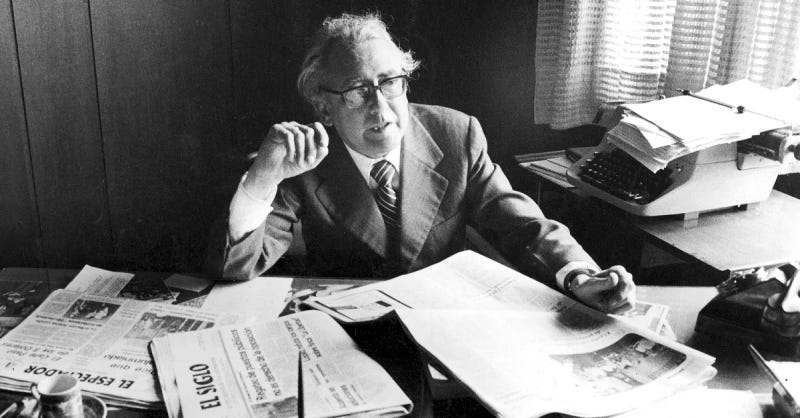
(Guillermo Cano Isaza (12 August 1925 – 17 December 1986) was a Colombian journalist, editor of El Espectador from 1952 until 1986 when he was assassinated in Bogotá as a result of his newspaper’s campaign against how the country’s drug barons were interfering with its politics. In 1997 the UN named a press freedom award in his honour to celebrate those who make an outstanding contribution to press freedom while working in dangerous and difficult conditions.)
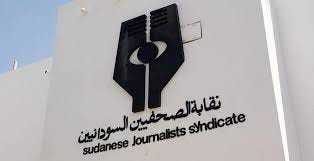
Without fuss or fanfare—and with little outside support-- the SJS has been working from a whitewashed building in central Khartoum to facilitate the reporting of the horrific civil conflict that has terrorised and paralysed the country since April 2023.
In that time the two opposed military forces The Rapid Support Forces (RSF) and the Sudanese Armed Forces (SAF) have committed widespread abuses, including extrajudicial killings, sexual violence, and rampant looting, as well as destruction of civilian infrastructure.
As Human Rights Watch reports: “… The RSF and allied militias have committed war crimes and crimes against humanity in a campaign of ethnic cleansing in West Darfur. Tens of thousands of people have been killed and more injured. An estimated 12.9 million people have fled their homes; half the country’s population faces acute hunger, and famine is spreading.”
Since the fighting began broke out in 2023, the Syndicate has documented 32 journalists’ deaths; 556 violations against media workers, and the shuttering of numerous newspapers and radio stations, establishing Sudan as one of the most dangerous countries to be a journalist.
The ongoing conflict in Sudan has severely disrupted news gathering. Yet the SJS has documented journalists being threatened with violence, and arrest andrecorded how 90% of the country’s media infrastructure has been destroyed. Journalists end up trapped in their homes or workplaces due to street violence. Internet and telecommunications blackouts further restrict the ability to report and verify events.
This has meant that the country has become a ‘zone of silence’, leaving large sections of the population in a ‘reliable information vacuum’ where mis- and disinformation spread unchallenged, fuelling hatred and polarisation.
But through all this the SJS continues to campaign for safe passage for journalists and civilians in war zones, as well as justice for those journalists who have been killed.
Health coverage
In the midst of war they provide health coverage for their more than 1300 members while fighting for minimum wage, health benefits and social insurance for them. And in 2024 they managed to train 185 journalists in El-Gadarif the capital of the state of Al Qadarif.
The SJS pledges to defend the freedom and professionalism of the press in order to contribute to the democratic and civil transformation of Sudan.
“The members of the Sudanese Journalists Syndicate have demonstrated extraordinary courage and unwavering dedication. Despite immense challenges, they continue, day after day, to deliver accurate, lifesaving information to their communities when it matters most. Their commitment is a powerful example to us all and a vital service to truth, accountability, and peace.”
Khaled El-Enany UNESCO Director-General
Reference
Sudanese Journalists Syndicate
5 minute read
Resisting the Taliban: how courageous female journalists are covering the plight of Afghan women from exile

It is difficult to imagine that there has been any more remarkable and courageous investigative journalism outlet launched over the past five years than Zan Times.
Zan Times is an online, women-led investigative newsroom which covers women’s issues, human rights violations and the plight of marginalised communities in Afghanistan. Founded in August 2022 by leading Afghan-Canadian journalist Zhara Nader, the outlet operates in exile from her home in Edmonton, Alberta. It publishes in English and Farsi/Persian (including Dari).
When the Taliban made their swift and dramatic return to power in 2021 Nader was studying in Canada, and although she was poised to return, she realised how dangerous and difficult that would be. Launching Zan Times was a direct response to the almost immediate deterioration in human rights and living conditions in the country.
Zan means ‘women’ in Farsi and there were compelling reasons to focus on the situation facing women in Afghanistan.
Stay at home
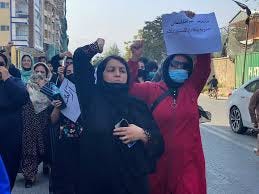
Since the Taliban takeover women have been ordered to cover their bodies and faces in public and advised to stay at home. They also have been banned from most government jobs and prohibited from using gyms and parks. They are also not allowed to attend high school and college—the only country in the world to ban women from secondary education.
In 2023 a senior UN representative based in Kabul described Afghanistan as the most repressive country in the world for women (although emphasising the importance of maintaining open channels with the Taliban).
Zan Times has taken on fighting this situation with courage, innovation and tenacity. In a 2023 report on Zan Times by the Global Investigative Journalism Network(GIJN) freelancer Laura Oliver explained how it was essential for the outlet to develop two groups of Afghan journalists: one group inside the country and a group of editors who are mostly in exile.
She added: “Having women journalists on the ground is crucial for building trust with sources, many of whom are scared of recrimination if they talk about the Taliban.
“The security and safety of the 12-strong team is of the utmost concern. For contributors in Afghanistan, pen names are used on stories and they work in isolation, not connected to their colleagues within Afghanistan or sharing their work with family and friends to prevent the network from being traced through an individual.”
Although as a non-profit, Zan Times struggles with funding, they make every effort to ensure their reporters in Afghanistan get paid properly and are looked after.
With the courage of those on the ground in Afghanistan the Zan Times have been able to conduct investigations into the murders and disappearances of protesters by the Taliban, forced marriages, and the lives of Afghanistan’s Kuchis or nomadic women.
One of their most significant investigations was about the high rate of suicide among Afghan women since the return of the Taliban. In order to bring tis project to fruition It took eight months of tenacious and detailed reporting, establishing important bonds of trust with their sources.
This investigation earned Zan Times the Human Rights Press Award in 2024 followed by the Pen2Pen Freedom of Expression Award for their courageous journalism in 2025.
Only a few days ago Zan Times published a major feature about how women have been excluded from journalism and media jobs in Afghanistan as part of the outlet’s marking of Press Freedom Day. The report was attributed to Rad Radan and Yalda Amini, pen names for two of their reporters..
They wrote: “Zan Times interviewed 23 women journalists and women media workers across seven provinces of Afghanistan ahead of World Press Freedom Day. Their testimony shows a profession collapsing under multiple pressures.
Women’s passion for journalism
“ Taliban officials restrict women’s movement, voices, images, and public presence. Media owners use women’s passion for journalism to extract unpaid or underpaid labour. Some journalist-support structures reproduce the same abuses of power they are meant to challenge. Meanwhile, families, fearful of shame and retaliation, often become another layer of restriction.
“At least 15 of the women interviewed by Zan Times say they had left, were forced to leave or laid off from journalism, social media work, or a specific media job because of harassment, not being paid for their work, Taliban threats, nepotism, family pressure, or unsafe working conditions.
“At least five said men in positions of power — including media managers, Taliban members, or figures connected to journalist-support structures — had pressured them for marriage, sex, or relationships.”
The report concludes: “One woman said she was asked for sex in exchange for work or assistance. Another, a divorced journalist with a daughter, said a man connected to a journalist-support body used her divorce to sexually harass her, implying that because she was divorced she should be available for sex.
“Their stories show that Afghan women journalists have not disappeared because they lack courage, skill, or commitment. They are being pushed out by a system that punishes their visibility, exploits their labour, and leaves them alone to carry the consequences.”
Difficult to exaggerate
It is difficult to exaggerate the dangers that running an outlet like Zan Times involves. Even for those working outside Afghanistan.
About a year after Zan Times started up , the Taliban questioned members of Nader’s family in Afghanistan, trying to find out how the newsroom operated. She has warned her colleagues they face similar risks but most of them want to carry on with the work regardless.
One of her reporters in Afghanistan who works under the pen name Sana Atef admits the psychological pressure can be difficult to bear, but she is determined to continue.
As she related in a recent interview with the Women’s Media Center: “I’m often concerned that I’m putting my family in danger; they may face the consequences. But I need to do this work for the women of my country.”
Reference
Zan Times Press freedom coverage
Women’s Media Center Afghan Women’s newsroom in exile
It’s free to subscribe and you can cancel any time, so give it a try!
Contact us on greatjournalismwjm@gmail.com
Follow us on Facebook
facebook.com/whyjournalism matters